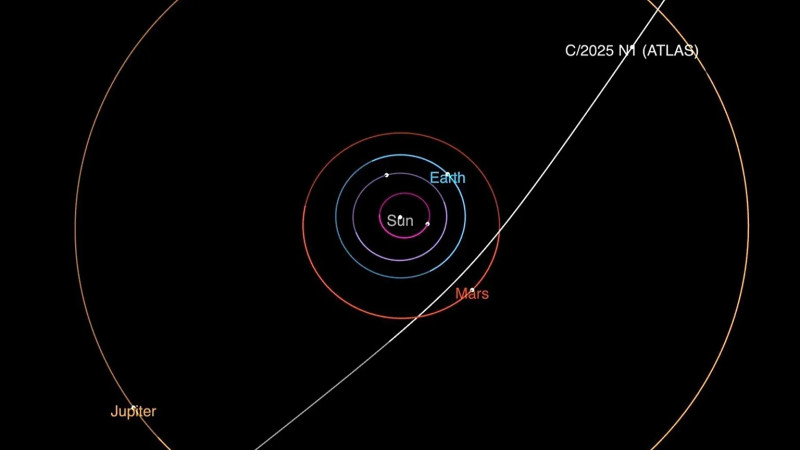
In an extraordinary celestial event, the interstellar comet 3I/Atlas is making its closest approach to Earth on December 19, 2025. This rare visitor from beyond our solar system is captivating astronomers and stargazers alike, offering a unique opportunity to observe an object that has traveled through the vast expanse of interstellar space.
Discovered on July 1, 2025, 3I/Atlas is the third known interstellar object to pass through our solar system, following 1I/'Oumuamua and 2I/Borisov. Its hyperbolic orbital path has led astronomers to classify it as an interstellar comet, meaning it originated from beyond our solar system.
As 3I/Atlas races past Earth at an astonishing speed of 130,000 mph, it will come within 170 million miles of our planet, roughly twice the distance from Earth to the Sun. This proximity, though still vast in astronomical terms, provides a rare chance to study an interstellar object up close. The comet's closest approach occurs overnight from Thursday, December 18, to Friday, December 19, 2025, offering a brief window for observation.
For those hoping to catch a glimpse of this celestial wanderer, NASA and other space agencies have provided valuable insights on how to locate 3I/Atlas in the night sky. The comet can be viewed with the aid of telescopes and binoculars, although its brightness and visibility will be best under clear, dark skies.
The European Space Agency's (ESA) X-ray space observatory, XMM-Newton, has also contributed to the study of 3I/Atlas by observing it in X-ray light. The observations, conducted on December 3, 2025, lasted for about 20 hours, providing a unique perspective on the comet's composition and behavior as it journeys through our solar system.
In addition to its scientific significance, 3I/Atlas has sparked speculation and excitement about the possibility of alien technology. While there is no concrete evidence to support this hypothesis, the comet's extraordinary nature and interstellar origins have fueled imaginative discussions and theories.
The journey of 3I/Atlas through our solar system is expected to continue well into 2026, offering astronomers and enthusiasts additional opportunities for observation and study. As the comet fades from view, it leaves behind a legacy of discovery and a deeper understanding of the mysteries that lie beyond our solar system.
This celestial event is not just a scientific milestone but also a reminder of the vast and awe-inspiring cosmos that surrounds us. As we gaze at 3I/Atlas, we are reminded of our place in the universe and the endless possibilities that await exploration. For now, the interstellar comet 3I/Atlas will continue its journey, leaving us with memories and insights that will endure long after it has vanished from our skies.