Comet 3I/ATLAS, the third known interstellar comet to visit our solar system, is making headlines as it approaches Earth on December 19, 2025. This cosmic traveler, discovered on July 1, 2025, has captured the attention of both astronomers and the public, offering a rare opportunity to study an object from beyond our celestial neighborhood.
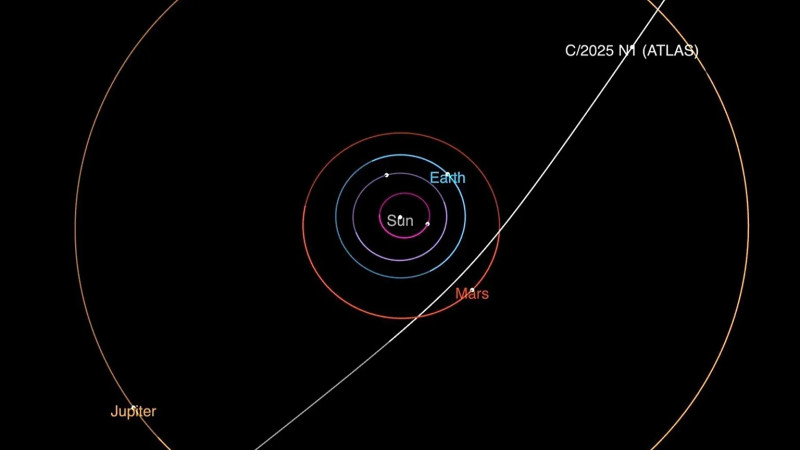
The comet's journey is marked by its hyperbolic orbit, a telltale sign of its interstellar origins. Unlike most comets that originate within our solar system, 3I/ATLAS hails from another star system, making its closest approach to Earth at approximately 170 million miles, roughly twice the distance between the Earth and the Sun.
NASA and the European Space Agency (ESA) have been closely monitoring 3I/ATLAS since its discovery, leveraging the Hubble Space Telescope and other advanced instruments to capture detailed images and data. One of the most striking images, taken on November 30, 2025, shows the comet at a distance of about 178 million miles from Earth.
While 3I/ATLAS will not come particularly close to Earth, its proximity offers scientists a unique chance to study its composition and behavior. The comet's trajectory, speed, and other characteristics provide valuable insights into the nature of interstellar objects and the conditions in other star systems.
Speculation has also arisen about the possibility of 3I/ATLAS being more than just a natural celestial body. Some experts, including Avi Loeb, have hypothetically suggested that it could be a manifestation of alien technology. This idea, while far from proven, adds an intriguing layer to the comet's mystique and underscores the fascination it has sparked.
For those eager to witness 3I/ATLAS, the best time to view it is tonight as it makes its closest approach. The comet's visibility will be enhanced by its position relative to Earth, making it a prime target for both professional and amateur astronomers.
This celestial event not only offers a rare glimpse into the cosmos but also serves as a reminder of the vast and mysterious universe beyond our solar system. As 3I/ATLAS continues its journey, it leaves behind a trail of wonder and a wealth of scientific data that will keep researchers busy for years to come.
The interstellar comet 3I/ATLAS has captivated astronomers and the public alike, offering a unique opportunity to study an object from beyond our solar system. Its hyperbolic orbit, speed, and composition provide valuable insights into the nature of interstellar objects and the conditions in other star systems. The comet's closest approach to Earth on December 19, 2025, marks a significant moment in astronomical history, one that will be remembered for its scientific contributions and the wonder it has inspired.