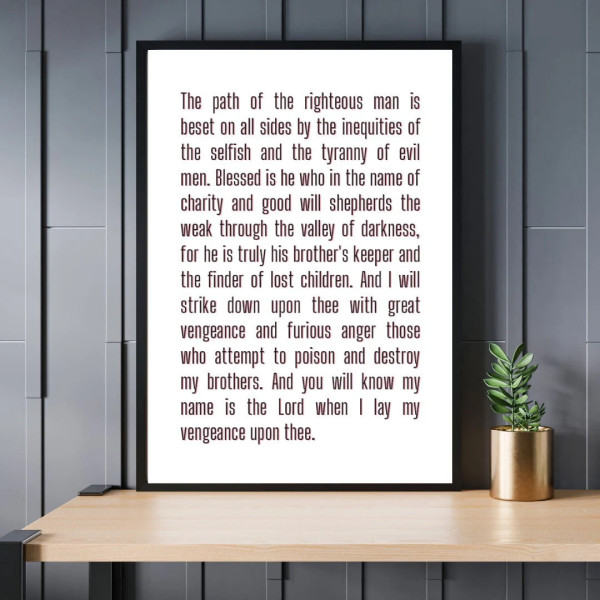
Secretary of Defense Pete Hegseth sparked a social media firestorm on Wednesday when he delivered a prayer at the Pentagon that closely echoed a famous monologue from Quentin Tarantino's Pulp Fiction rather than quoting the actual Ezekiel 25:17 Bible verse.
Hegseth Delivers Infamous 'Pulp Fiction' Prayer at Pentagon Service
The controversy erupted during a worship service at the Pentagon, where Hegseth’s prayer closely mirrored the iconic scene from Pulp Fiction in which the character Jules Winnfield, played by Samuel L. Jackson, delivers a violent and vivid monologue. This monologue, though inspired by the Bible verse Ezekiel 25:17, was significantly altered by Tarantino for dramatic effect. The words used by Hegseth during his prayer were nearly identical to those from the film, causing many to question the authenticity of the prayer.
The Controversial Prayer and Public Reactions
The event drew immediate attention and reaction from the public. Videos of the prayer quickly went viral, sparking debates about the appropriateness of using a fictionalized version of a Bible verse in an official military setting. Some viewers argued that it was a disrespectful or inappropriate choice, while others saw it as a creative interpretation of scripture. The incident also raised questions about the public’s expectations for the authenticity of religious practices within government institutions.
After the incident, Hegseth and Pentagon officials faced criticism from religious scholars and the public alike. The Pulp Fiction prayer was widely shared on social media, leading to a series of discussions and debates. Critics pointed out that using a fictionalized version of a Bible verse in a prayer could mislead the audience and undermine the integrity of the religious service.
The controversy highlights the delicate balance between creativity and authenticity in religious practices, particularly in public and official settings. It also underscores the potential for misunderstandings and misinterpretations when fictional narratives and religious texts intersect. As the debate continues, the incident serves as a reminder of the importance of accuracy and respect in religious contexts, especially within government institutions.
“Pete Hegseth's use of a fictionalized prayer in a military context raises important questions about authenticity and appropriateness in public religious practices. It is a reminder of the need for care and accuracy in such sensitive matters.” — Religious scholar and commentator.
The Real Ezekiel 25:17 and Its Misrepresentation
The actual Ezekiel 25:17 verse from the Bible is very different from the one used in Pulp Fiction. The biblical verse reads, “I will execute great vengeance on them with wrathful rebukes. And they will know that I am the Lord, when I lay my vengeance upon them.” This verse is significantly more subdued and lacks the dramatic flair of the fictional version used in the film.
Tarantino’s adaptation, as delivered by Jules Winnfield, includes phrases such as “and I will strike down upon thee with great vengeance and furious anger” and ends with a dramatic declaration, “And you will know my name is the Lord when I lay my vengeance upon thee.” This version, though powerful in its cinematic context, is far from the original biblical text.
Pete Hegseth's decision to use this fictionalized prayer during a Pentagon worship service has led to widespread speculation about the reasons behind his choice. Some suggest it was a creative interpretation meant to engage the audience, while others argue it was a deliberate attempt to evoke the emotional impact of the film. Regardless, the outcome was a public controversy that has reignited discussions about the boundaries of religious practice in official settings.
Is the Pentagon ready for a Pulp Fiction revival?