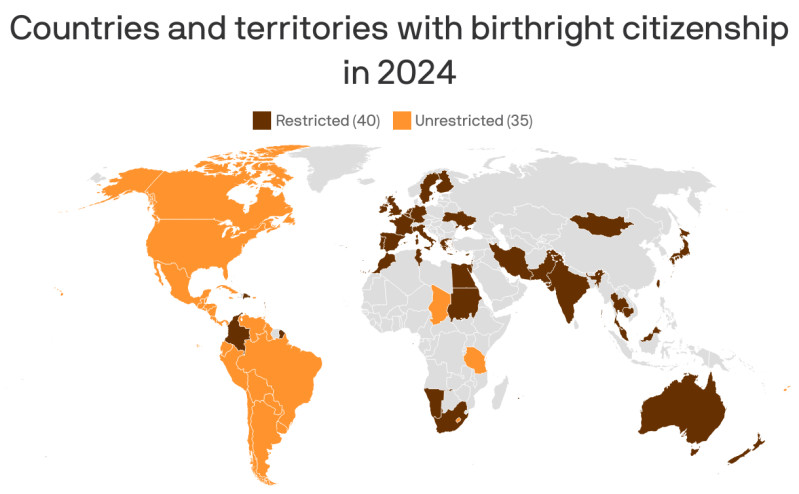
A child born in the United States is automatically a citizen, regardless of the parents' immigration status. This principle, known as birthright citizenship, is a cornerstone of American law and a subject of fierce debate. But the U.S. is far from alone in its policy. Around the globe, 33 countries and two territories grant unrestricted birthright citizenship, also known as jus soli .
What is birthright citizenship and how widespread is it?
The term jus soli — "right of the soil" — describes the legal principle that the place of birth determines citizenship. This contrasts with jus sanguinis, or "right of blood," where citizenship is conferred based on parental lineage. Among the 33 nations that practice unrestricted birthright citizenship are Canada, Mexico, Brazil, and Argentina, among others .
However, the majority of the world's countries do not offer unrestricted birthright citizenship. Those that do not include many European and Asian nations, where citizenship is typically determined by parental nationality or descent. In total, only 33 countries practice unrestricted birthright citizenship, while many others have more limited versions of the policy .
Why birthright citizenship matters: The Wong Kim Ark case
The significance of birthright citizenship was underscored in the landmark 1898 Supreme Court case, United States v. Wong Kim Ark. Wong Kim Ark, born in San Francisco to Chinese immigrant parents, was denied re-entry to the U.S. after traveling abroad. The court ruled in his favor, affirming that anyone born in the United States is a citizen, regardless of their parents' status .
This ruling remains a fundamental tenet of American law. However, it has been subject to scrutiny in recent years. In 2015, Cecilia Wang and the American Civil Liberties Union (ACLU) took up the case of a pregnant woman facing deportation. The ACLU argued for the woman’s right to give birth in the US and subsequently have her child granted citizenship. This case, which was ultimately settled out of court, highlights the ongoing relevance and critical importance of birthright citizenship .
The principle of birthright citizenship has far-reaching implications. It is a cornerstone of American national identity, shaping how the nation views itself and its role in the world. Despite its significance, the policy remains a contentious issue, with debates raging over its potential impact on immigration, national security, and cultural cohesion.
The future of birthright citizenship laws: A global perspective
Yet, the future of birthright citizenship is not clear. As the world grapples with increasing migration and shifting demographics, countries are re-examining their citizenship laws. Will more nations adopt unrestricted birthright citizenship? Or will the trend move towards more restrictive policies, prioritizing parental nationality or legal residency? .
One thing is certain: the debate over birthright citizenship is far from over. It touches on fundamental questions of national identity, belonging, and the rights of individuals. As countries continue to navigate these complex issues, the principle of birthright citizenship will remain a vital part of the conversation.
“Citizenship is more than a piece of paper; it is a bond between a person and a nation, a commitment to shared values and a collective destiny. The path forward for birthright citizenship will shape not only individual lives but the very fabric of societies around the world.” - Expert in International Immigration Law.
What will the future of birthright citizenship look like? Will the principle of jus soli become more widespread, or will it face increasing restrictions and exceptions? What does the future hold for those born in countries where citizenship is born out of the parents' lineage and not the land they were born in?