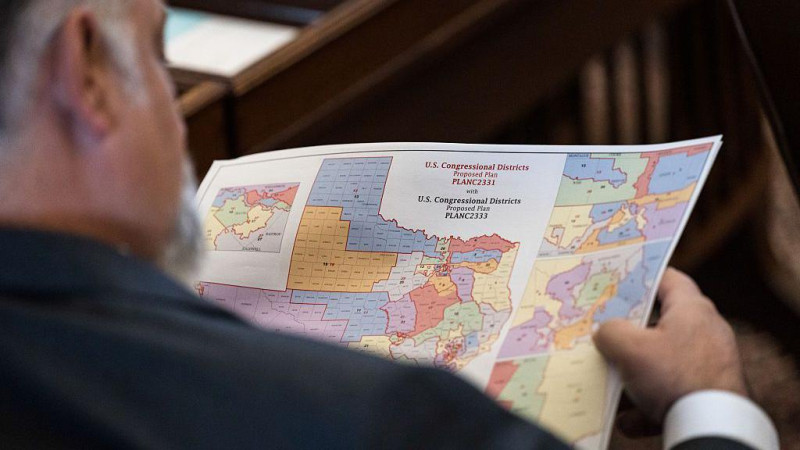
The Supreme Court has taken a decisive step in the ongoing legal battle over Texas's congressional redistricting by allowing the state to use its newly drawn map for the 2026 elections. This ruling, which has significant implications for the balance of power in the state, comes amidst a complex legal landscape and widespread criticism over allegations of racial discrimination and gerrymandering.
The Supreme Court's decision to permit Texas to use its redistricting map, which is widely seen as favorable to Republicans, has sparked a range of reactions. The map, engineered to give the GOP control over 30 of the state's 38 congressional districts, was challenged on the grounds of racial discrimination and violation of the Voting Rights Act.
The court's move has been interpreted as a major victory for the Republican Party, which has long sought to maintain its stronghold in Texas despite a growing and increasingly diverse population. The decision allows Texas to proceed with the 2026 midterm elections under the new map, which has been a central point of contention in various lawsuits.
The legal battle surrounding Texas's congressional redistricting plan has been particularly contentious, with multiple challenges filed alleging intentional racial discrimination, racial gerrymandering, and violations of the Voting Rights Act. These challenges have created a complex and evolving litigation landscape, with no final resolution in sight as of late 2025.
Civil rights groups, including the League of United Latin American Citizens (LULAC), the Mexican American Legal Defense and Educational Fund (MALDEF), the Texas NAACP, and Fair Maps Texas Action, have been at the forefront of the opposition. They argue that the new congressional districts map disproportionately dilutes the voting power of minority communities, thereby violating the principles of fair representation and equal protection under the law.
The Supreme Court's order, which came in the form of a brief, unsigned opinion, effectively grants a stay, allowing Texas to use the map in the upcoming elections while the legal battle continues. This move has been criticized by opponents who argue that it undermines the judiciary's role in safeguarding civil rights and ensuring fair representation.
Despite the ongoing legal challenges, the Supreme Court's decision represents a significant turning point for Texas's political landscape. The state's redistricting efforts have long been a flashpoint for controversy, with accusations of partisan gerrymandering and racial discrimination frequently surfacing. The current map, which has been described as a "Republican-friendly" plan, is likely to impact the balance of power in the state for years to come, potentially influencing the outcome of key elections and shaping the political narrative in Texas.
As the legal drama unfolds, it remains to be seen how the Supreme Court's decision will influence future redistricting efforts in Texas and across the country. The ongoing battle over voting rights and fair representation is a critical issue that will continue to shape the political landscape in the years ahead, raising important questions about the role of the judiciary in ensuring a fair and democratic electoral process.