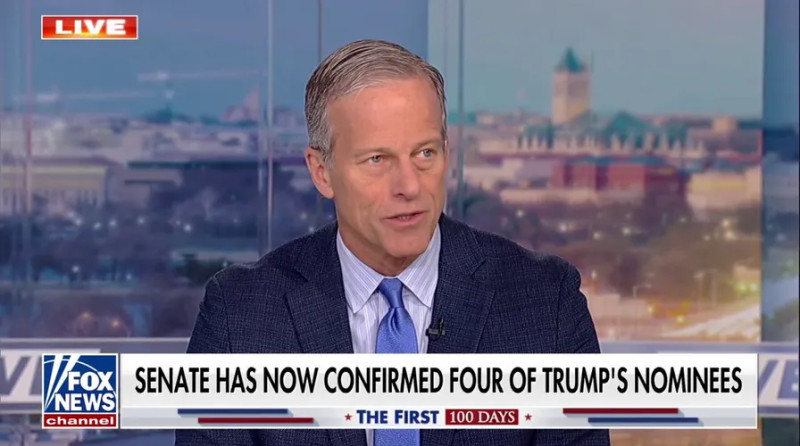
On Tuesday, April 15, 2026, the Senate found itself in a state of heightened anticipation and strategic planning. As the clock ticks closer to the upcoming midterms and the potential retirement of Justice Samuel Alito looms, the corridors of the Senate are buzzing with preparations to fill any potential Supreme Court vacancy swiftly. Senate Majority Leader John Thune of South Dakota is at the forefront of these plans, signaling the Republican Party's readiness to move forward with a confirmation process that could reshape the highest court in the land.
The Republican Strategy: Swift Confirmation and Strategic Maneuvers
As John Thune readies the Senate for a potential SCOTUS confirmation process, the Republican strategy has become clear: expedite and streamline. Thune, known for his meticulous planning and strategic maneuvers, has hinted at a potential 'nuclear option' to hasten the confirmation of lower-level nominees . This parliamentary maneuver, colloquially known as the 'suitcase nuke,' involves overriding procedural hurdles to ensure a more efficient confirmation process. Thune's comments came as a response to the looming possibility of a Supreme Court vacancy before the midterms, emphasizing the GOP's commitment to a swift and decisive confirmation process. This strategy is part of a broader plan to bolster the conservative majority on the Supreme Court, ensuring that any new justice aligns with the party's ideological leanings.
Thune’s readiness contrasts sharply with the procedural hurdles and partisan battles that have often slowed down the confirmation process in the past. By preparing to use the 'nuclear option,' Thune aims to bypass potential filibusters and other delays, ensuring that any nominee can be confirmed with minimal resistance. This move is seen as a bold assertion of Republican control over the Senate, particularly in light of the contentious political climate surrounding judicial appointments, and the persistent threat of a talking filibuster that has become a contentious issue in recent months. The filibuster, a procedural tool that allows senators to prolong debate and delay votes, has been a point of contention between the parties, with Democrats often accused of using it to obstruct Republican agendas.
Thune has also been vocal about the need to maintain the integrity of the Senate’s procedural norms, even as he prepares for a swift confirmation process. He emphasized that the Senate is not only ready but also prepared to swiftly confirm any Trump nominee for a SCOTUS vacancy, ensuring that the court remains aligned with conservative principles. This stance underscores the Senate’s commitment to upholding its constitutional duties while navigating the complexities of a divided political landscape. The GOP’s approach reflects a broader strategy to consolidate power and ensure that the Senate remains a bastion of conservative influence.
Thune's Views on Filibuster and Voting Legislation
While Thune has been vocal about the Senate’s readiness to confirm a new Supreme Court justice, his views on the filibuster and voting legislation have been equally illuminating. Speaking to reporters, Thune emphasized that the filibuster remains a critical tool for maintaining the integrity of the Senate’s deliberative process, even as he acknowledged the potential for its misuse. He clarified that while the filibuster could be seen as an obstacle, it is also a safeguard against hasty and ill-considered legislation. Thune's stance on the filibuster is a nuanced one, reflecting the delicate balance between procedural efficiency and the need for thorough debate.
In a recent interview, Thune said, "I’m not saying we should do away with the filibuster entirely. But we need to use it responsibly, and that means ensuring that it doesn’t become a tool for partisan obstruction. We need to ensure that the Senate remains a place where bipartisan cooperation can thrive, even as we move swiftly to confirm our nominees."
Thune's comments also come in the wake of President Trump's push for the SAVE America Act, a voting legislation designed to safeguard the integrity of the electoral process. Thune has been cautious about the prospects of this legislation, acknowledging the partisan divides that have made it a contentious issue in recent months. He cautioned that while the Senate is prepared to act swiftly on judicial confirmations, the same cannot be said for legislative initiatives. Thune's position underscores the Senate's commitment to maintaining its procedural integrity while navigating the complexities of a polarized political landscape.
“The votes aren’t there to nuke the filibuster, and the votes aren’t there for a talking filibuster either. We need to find a way to work within the system, not against it,” Thune stated, emphasizing the need for bipartisan cooperation and a commitment to the Senate’s procedural norms.
What’s Next for the Senate and the Supreme Court?
As the Senate gears up for a potential SCOTUS confirmation, the political atmosphere remains charged with anticipation and uncertainty. Thune's comments have set the stage for a swift and decisive confirmation process, one that could have far-reaching implications for the Supreme Court and the broader political landscape. With the midterms looming and the potential retirement of Justice Alito still a possibility, the Senate's preparations reflect a deep commitment to maintaining conservative influence on the highest court in the land.
The Senate's readiness to confirm a new justice, coupled with Thune's strategic maneuvers, underscores the Republican Party's determination to shape the Supreme Court in its image. As the political landscape continues to evolve, the Senate's actions will be closely watched, with the potential for significant shifts in the balance of power within the highest court. The upcoming months promise to be a period of intense political activity and strategic maneuvering, as the Senate prepares to navigate the complexities of a divided political landscape and a potential Supreme Court vacancy.
If Thune's strategy comes to fruition, we could see a new justice confirmed before the midterms, reshaping the Supreme Court and setting the stage for a new era in American jurisprudence.
"We’re ready to act, and we’ll do so swiftly. The people need to know that the Senate is prepared to fulfill its constitutional duties, even as we navigate the challenges of a divided political landscape."
— John Thune