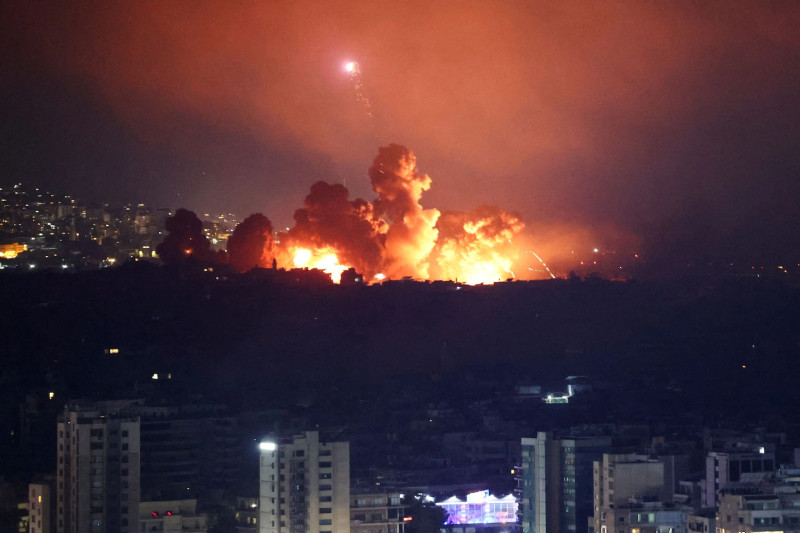
Israeli jets pummeled Beirut and Lebanon's southern suburbs today, in what the Israeli military described as a devastating barrage on Hezbollah. The largest coordinated strike in the current war, the attack hit more than 100 key targets in 10 minutes, leaving Beirut shrouded in thick, black smoke . The strikes come in the wake of a US-Iran ceasefire, further escalating the conflict in the region.
Heightened Tensions and Escalations
Israeli airstrikes targeting central Beirut, an area rarely hit since the current war's outbreak, signal a dangerous new phase in the ongoing conflict . The Israeli military’s intensified assaults across Lebanon have resulted in a staggering death toll, with at least 254 people killed in the past week alone . The scale of these attacks, described as the most powerful since the war began, has turned the fragile ceasefire into a distant memory.
The Israeli military has been relentless in its strikes, launching waves of attacks that have left Lebanon in ruins. The Lebanese government has reported that these strikes have caused widespread devastation, turning joy over the ceasefire into a nightmare for many . The situation is so dire that Lebanon's Civil Defense has issued urgent calls for support as the humanitarian crisis deepens.
Hezbollah's Role and Iranian Influence
The conflict is deeply intertwined with Hezbollah, an Iran-aligned proxy force in Lebanon. Hezbollah has been a key player in the region, with its infrastructure becoming a primary target for Israeli forces. Israeli authorities have issued evacuation warnings for large parts of Beirut and southern Lebanon, indicating the extensive nature of the planned attacks . The Israeli military's strategy seems to aim at crippling Hezbollah's capabilities, even if it means devastating civilian areas.
Despite the ceasefire between Iran and the US, Israel continues its aggressive stance against Hezbollah. The devastation in Lebanon is a stark reminder of the broader conflict that has embroiled the region for years. The Iranian influence in Lebanon, largely through Hezbollah, has been a consistent rallying point for Israeli military actions.
Impact on Lebanon and the Region
Lebanon is bearing the brunt of these attacks, with the death toll rising sharply. Lebanon's health ministry reported that Wednesday's strikes in Beirut resulted in the highest single-day death toll in the ongoing war, with at least 182 people killed . The humanitarian crisis is worsening, with hospitals and medical facilities overwhelmed by the influx of casualties. Lebanon's infrastructure, already fragile, is being further decimated by the relentless strikes.
The attacks have also drawn attention to the broader conflict with Iran, which has been a significant factor in the region's instability. The Israeli military’s operations in Lebanon are part of a larger strategy to weaken Iran’s influence in the region. The continued aerial bombardments highlight the strategic importance of Lebanon in the broader conflict and underscore the severity of the situation.
"The current escalation is a clear indication that Israel is not backing down from its aggressive stance against Hezbollah and Iran," said a military analyst. "The data is damning, showing that Israel's strategy is relentless and unyielding in its pursuit of its objectives, even if it means risking further destabilization in the region ."
Let's not kid ourselves, the conflict is not solely about Israel and Hezbollah. The broader geopolitical landscape, with Iran and the US playing central roles, adds a complex layer to the situation. The ceasefire between Iran and the US, which was supposed to bring some stability, has had the opposite effect. The attacks on Lebanon are a clear signal that the region is far from stable, and the conflict is far from over.