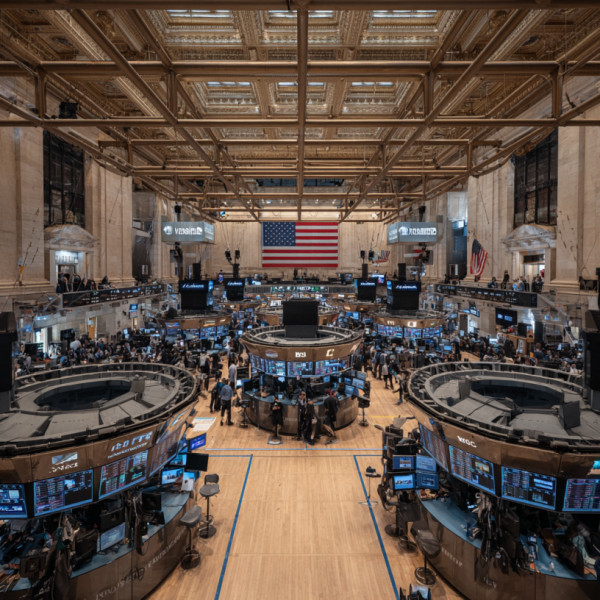
The fluorescent glare of the briefing room at CNBC headquarters reveals a scene of heightened tension as traders and analysts monitor the volatile market movements of the Dow Jones Industrial Average. The hum of phones buzzing in pockets and the rapid click-clack of keyboards signal the urgency of the day's trading session. "The Dow is looking pretty shaky today," mutters a seasoned trader, eyes glued to the screens displaying real-time stock quotes and financial information, as the market data flashes with the latest stock market news .
DJIA Sheds Points Amid Global Uncertainty and Macroeconomic Tensions
As the clock struck 16:07:23 (UTC) on April 7, 2026, Dow Jones Industrial Average (DJIA) saw a significant decline, shedding 371.38 points to close at 46,298.50, marking a 0.80% drop. The day's trading was marked by broad-based selling, particularly in the technology and growth sectors. Analysts pointed to various factors contributing to the market's downward spiral. The imminent deadline for Hormuz tensions and its potential impact on global energy supplies weighed heavily on investors' minds. The Nasdaq Composite, a primary indicator of the tech sector's health, bore the brunt of the selling pressure, plummeting 289.41 points or 1.32%, to 21,706.93. — The tech sector's struggles are also causing investors to reassess valuations and sentiment, with the S&P 500 falling 62.80 points, or 0.95%, to close at 6,549.03 .
Investors also grappled with economic reports and geopolitical uncertainties. The energy sector, which had been a relative haven in recent months, saw a sharp retreat as oil prices dropped in response to the Hormuz tensions. Small-cap stocks, often more volatile and sensitive to economic fluctuations, also faced significant pressure. The S&P 500, a broader gauge of the market, mirrored this sentiment, ending the day in the red. — The broader market decline is likely to draw more attention to safe-haven assets and defensive sectors .
Sector Performance and Market Sentiment
Despite the overall market weakness, some sectors showed relative resilience. The healthcare sector, for instance, managed to hold its ground, buoyed by strong earnings reports from major pharmaceutical companies. Financials also fared better than many other sectors, benefiting from rising interest rates and a stable banking environment. The consumer goods sector, often seen as a defensive play in uncertain times, also performed well . — The retail sector, however, faced challenges as investors worried about the potential impact of economic uncertainty on consumer spending. Analysts at CNBC and MarketWatch suggest that the market's volatility is likely to continue in the near term, with investors closely monitoring economic indicators and geopolitical developments. — Analysts caution that the current market environment is fraught with risks and uncertainties, advising a cautious approach to investments .
Analyst Insights: What Lies Ahead for Dow Jones Industrial Average
In the midst of the market turmoil, experts offer varied perspectives on the future trajectory of the Dow Jones Industrial Average. Some analysts believe that the current sell-off is a temporary correction, pointing to strong fundamentals and robust economic data. Others, however, warn of a more prolonged downturn, citing geopolitical risks and potential economic headwinds. "The market is clearly in a state of flux," says a senior analyst at CNBC, "but it's crucial to distinguish between short-term noise and long-term trends. Investors should focus on companies with strong balance sheets and resilient business models." — Another expert from Reuters added, "We are in uncharted waters, and the market's reaction to recent events underscores the need for a diversified investment strategy." .
As the market continues to navigate these choppy waters, investors are advised to stay informed and vigilant. The Dow Jones Industrial Average, a barometer of market health, remains a focal point for traders and analysts alike. The next few weeks will likely see continued volatility as investors digest the latest economic data and geopolitical developments. CNBC's ongoing analysis and real-time stock market data provide essential insights for navigating this complex landscape, offering a beacon of clarity amid market volatility .
“The market is clearly in a state of flux, but it's crucial to distinguish between short-term noise and long-term trends,” cautioned a senior analyst at CNBC .