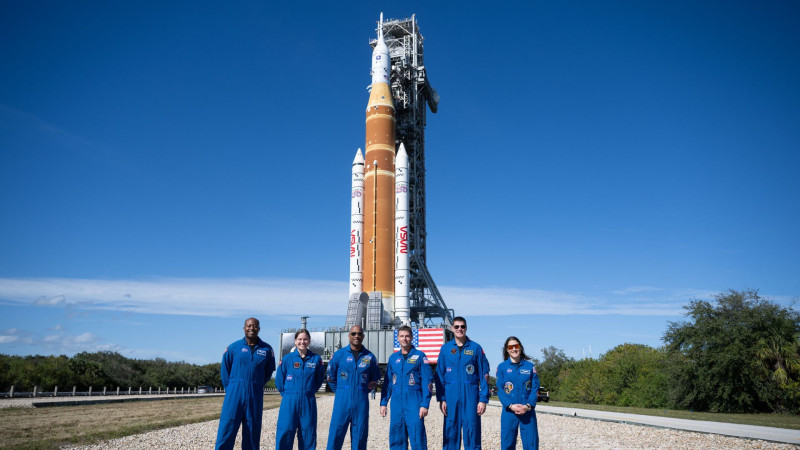
NASA’s Artemis II mission has captivated the world, and at the heart of the excitement is Jim Lovell, a true legend of space exploration. The Artemis II mission is currently making history, with astronauts on a trajectory around the far side of the moon, a region Lovell himself explored during the Apollo 13 mission. He was never so close to the moon during his Apollo days.
Jim Lovell and the Apollo 13 Echo
The Jim Lovell legacy echoes loudly in the Artemis II mission. Having survived the infamous near-disaster of Apollo 13, Lovell is the living embodiment of resilience and innovation in space exploration. It’s a poignant reminder of the human spirit’s unyielding pursuit of knowledge and adventure. Now, Artemis II has already broken the Apollo 13 record for the farthest humans have ever traveled away from Earth. This mission, like Apollo 13, is intended to break records and test limits. In 1970 the Apollo 13 crew traveled 248,655 miles from Earth. Artemis II will reach a maximum distance of 252,757 miles from Earth. As the Artemis II crew heads home, Lovell’s ghost is ever-present.
Artemis II: Making History
Artemis II is the second leg of NASA’s ambitious plan to return humans to the moon and eventually to Mars. The mission, currently underway, involves four astronauts on a journey that will take them around the moon and back to Earth. The crew includes Reid Wiseman, Victor Glover, Christina Koch, and CSA. The Artemis II spacecraft, named Integrity, is on a free-return trajectory, meaning it will swing around the moon’s far side and use lunar gravity to slingshot back to Earth. The crew's return journey began on Tuesday, April 7, 2026. After the lunar flyby, the spacecraft will spend about four days returning to Earth. The reentry, expected to be intense with temperatures reaching 5,000 ℉, will be the most dangerous part of the mission.
The Moon’s Dark Side and Beyond
On April 6, 2026, the Artemis II crew completed the lunar flyby and embarked on their return to Earth. During this phase, the crew will experience a total solar eclipse from their unique vantage point: the moon passing in front of the sun.This is a rare and spectacular sight, one that Jim Lovell and his Apollo 13 crewmates would have marveled at. At its closest approach to the moon, the Artemis II spacecraft will be just 80 miles (130 kilometers) from the lunar surface. It is a profound reminder of the vastness of space and the daring of human exploration.
Even with the Artemis II mission's current success, the future of space exploration is already being shaped by the accomplishments of those who came before. Lovell’s legacy is a testament to the resilience and innovation that drives humanity to explore the unknown. As the Artemis II crew prepares for their return to Earth, the world watches, inspired by the legacy of Jim Lovell and the promise of future missions.
It’s an exciting time for space exploration, and the Artemis II mission is just the beginning. As we watch the crew’s journey unfold, we can't help but think of the historic parallels—Jim Lovell and his crew’s journey on Apollo 13. The crew is scheduled to splashdown on April 10, 2026, just as Lovell's crew returned home. We are reminded of how far we’ve come, and how much further we have yet to go.